Voltra
What the Gulf's official food guides say
All six Gulf countries publish official food guides: Saudi Arabia's Healthy Food Palm [1], Kuwait's Food-Based Dietary Guidelines [4], the UAE's National Nutrition Guidelines [5], Qatar's Dietary Guidelines [6], Bahrain's guide [7] and Oman's Guide for Healthy Eating [8]. They agree on the basics: a variety of foods, plenty of vegetables and whole fruit, whole grains, low-fat dairy, fish, less sugar, salt and saturated fat, water, and regular activity.
They differ on the numbers. Most put salt at under 5 g a day; sugar limits run from 6 teaspoons of added sugar in Kuwait to under 10% of calories elsewhere; and water advice runs from about 6 cups to 3 litres a day.
The numbers, side by side
| Country | Salt | Added sugar | Water |
|---|---|---|---|
| Saudi Arabia (2012) [1][3] | No number in the Arabic edition; the English one says under 2.3 g of salt | Avoid sugary foods; no number | 1.5 litres, about 6 cups |
| Kuwait (2023) [4] | Under 5 g (2,000 mg sodium) | No more than 6 teaspoons (25 g) | 3.7 litres men, 2.7 women (total water) |
| UAE (2019) [5] | No more than 6 g; under 2,300 mg sodium | Under 10% of calories, ideally 5% | 6 to 8 cups |
| Qatar (2015) [6] | Under 2,000 mg sodium, about 5 g of salt | Cut down; no number | 2 to 3 litres of fluids |
| Bahrain (2023) [7] | Under 5 g (under 2 g sodium) | Under 10% of calories, about 12 teaspoons; ideally under 5% | 2.7 litres women, 3.7 men, including water from food |
| Oman (2026) [8] | No more than 2,000 mg sodium, about a teaspoon | Under 10% of energy, with more benefit under 5% (WHO) | 3 litres men, 2.2 women |
Kuwait's Arabic edition prints "5 mg" of salt, a typo; its English edition and icon say 5 g [4].
Vegetables and fruit a day
| Country | Vegetables | Fruit |
|---|---|---|
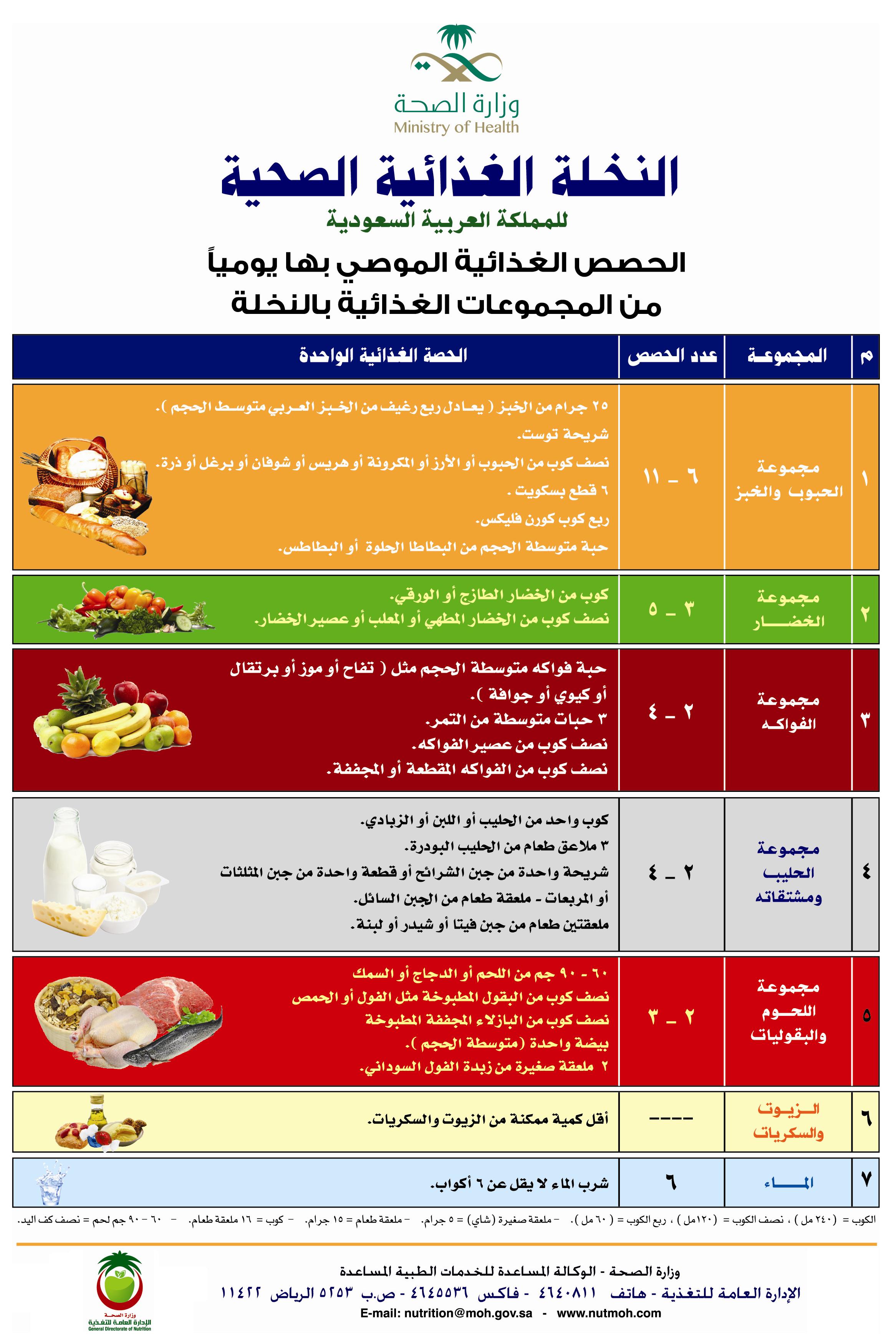
| Saudi Arabia [2] | 3 to 5 servings | 2 to 4 servings |
| Kuwait [4] | 3 to 5 servings | 4 servings |
| UAE (adults 19 to 50) [5] | 2.5 to 3 cups | 1.5 to 2 cups |
| Qatar [6] | 3 to 5 servings | 2 to 4 servings |
| Bahrain [7] | 2.5 to 4 servings | 1.5 to 2.5 servings |
| Oman (on 2,000 kcal) [8] | 2.5 servings | 2 servings |
The Saudi, UAE, Qatari, Bahraini and Omani guides all prefer whole fruit to juice [1][5][6][7][8].
What each guide says about local food
- Saudi Arabia: 3 medium dates count as one fruit serving, and a quarter of a medium Arabic flatbread as one grain serving [2].
- Kuwait: make traditional whole-grain dishes like harees and jareesh part of your diet, eat fewer fried sweets like luqaimat, and flavour coffee with ginger or cinnamon instead of sugar [4].
- UAE: one grain serving is a small khameer, one regag, half an Iranian bread or half a medium Lebanese bread; swap fried for grilled or boiled, and ghee and butter for small amounts of vegetable oil [5].
- Qatar: eat fish at least twice a week; cut down on maqdous and pickles and on salted laban drinks; soak salty white cheeses like halloumi and akkawi before eating; make sweets like sago with less sugar; wait about 30 minutes after a meal before drinking tea, to let iron from food be absorbed [6].
- Bahrain: eat oily fish such as sardines, meed, kanad (kingfish) and yanam at least once a week; cut down on mehyawa and dried fish; soak halloumi overnight; leave about 30 minutes between tea and meals [7].
- Oman: one fruit serving is 1 Medjool date, 2 Barhi dates, or 3 Khalas, Barni or Jabri dates [8].
Activity
Every guide pairs food with activity. Saudi Arabia's palm asks for 30 to 60 minutes a day [1]; Kuwait, the UAE, Qatar and Bahrain follow the WHO's 150 minutes of moderate activity a week [4][5][6][7]; and Oman's 2026 guide adds a target of 8,000 to 10,000 steps a day [8]. Only Qatar's guide mentions fasting: keep up healthy eating habits when you fast [6].
In Voltra
Voltra's food search includes the Gulf dishes these guides talk about, from harees to luqaimat, and you can log water on the Eat tab. See our Gulf food calorie table for their calories.
Frequently asked
How much salt do Gulf guidelines allow?
Kuwait, Qatar, Bahrain and Oman set under 5 g of salt, or 2,000 mg of sodium, a day; the UAE sets no more than 6 g; Saudi Arabia's Arabic guide gives no number.
How much water do the Gulf guides recommend?
From 1.5 litres (about 6 cups) in Saudi Arabia's guide to 3 litres for men in Oman's; Qatar says 2 to 3 litres of fluids a day.
Do the Gulf guides count dates as fruit?
Yes. Saudi Arabia counts 3 medium dates as one fruit serving, and Oman counts 1 Medjool, 2 Barhi, or 3 Khalas, Barni or Jabri dates.
Sources
- وزارة الصحة، المملكة العربية السعودية، الإدارة العامة للتغذية (٢٠١٢). الدليل الغذائي السعودي: النخلة الغذائية الصحية. In Arabic. Messages pp. 18–22.
- وزارة الصحة، المملكة العربية السعودية، الإدارة العامة للتغذية (٢٠١٢). جدول الحصص الغذائية (النخلة الغذائية الصحية). In Arabic. Servings poster.
- Saudi Ministry of Health, General Directorate of Nutrition (2012). Dietary Guidelines for Saudis: The Healthy Food Palm (English edition). Message 4.
- الهيئة العامة للغذاء والتغذية، الكويت (٢٠٢٣). دليل الكويت الإرشادي للنُّظم الغذائية. In Arabic. pp. 8–27.
- وزارة الصحة ووقاية المجتمع، الإمارات (٢٠١٩). الدليل الإرشادي الوطني للتغذية. In Arabic. pp. 9–35.
- المجلس الأعلى للصحة، قطر (٢٠١٥). الدلائل الإرشادية للتغذية لدولة قطر. In Arabic. pp. 10–29.
- وزارة الصحة، مملكة البحرين (٢٠٢٣). الدليل الإرشادي الغذائي لمملكة البحرين. In Arabic. pp. 29–70.
- وزارة الصحة، سلطنة عُمان (٢٠٢٦). الدليل العُماني للغذاء الصحي (النسخة المحدثة). In Arabic. pp. 29–127 (printed).
Sources checked on 30 September 2026. Page numbers are the printed pages of the Arabic editions.
Log your food and training with Voltra. Free to download; the yearly plan starts with a 7-day free trial. Works fully in English and Arabic.