Voltra
Calories in rice: cooked and raw, basmati and sella, per plate and per cup
Cooked white rice has about 130 kcal per 100 g, and a cup of it (158 g) about 205 kcal [2]. Weighed raw, the same rice has 365 kcal per 100 g [1]. The difference is the water the rice soaks up as it cooks: 100 g of raw white rice becomes about 280 g of cooked rice (calculated).
Cooked sella (parboiled) and brown rice are a little lower, about 123 kcal per 100 g [4][6], and USDA counts basmati as plain cooked white rice [7].
Calories per 100 g, raw and cooked
| Rice, per 100 g | kcal | Protein | Fat | Carbs |
|---|---|---|---|---|
| White, long-grain, raw [1] | 365 | 7.1 g | 0.7 g | 80.0 g |
| White, long-grain, cooked [2] | 130 | 2.7 g | 0.3 g | 28.2 g |
| Sella (parboiled), long-grain, raw [3] | 374 | 7.5 g | 1.0 g | 80.9 g |
| Sella (parboiled), long-grain, cooked [4] | 123 | 2.9 g | 0.4 g | 26.1 g |
| Brown, long-grain, raw [5] | 367 | 7.5 g | 3.2 g | 76.3 g |
| Brown, long-grain, cooked [6] | 123 | 2.7 g | 1.0 g | 25.6 g |
Raw means dry, before cooking. The cooked rows are plain rice with no fat added; oil or ghee adds to them (see below).
Basmati, sella and brown
- Basmati. USDA has no basmati entry of its own. Its survey database lists basmati and jasmine rice under plain cooked white rice, and builds that entry from the long-grain white rice above, at 129 kcal per 100 g [7].
- Sella. Sella is parboiled rice. USDA's parboiled long-grain rice has 374 kcal per 100 g raw and 123 cooked [3][4].
- Brown. Per 100 g cooked, it has the same calories as sella and more fibre than white rice: 1.6 g against 0.4 g [2][6].
Cooked sella and brown rice come out about 5% lower than white per 100 g because they hold a little more water: about 70 g per 100 g against 68 g [2][4][6].
A cup and a plate
We found no standard plate size, so weigh your plate, or use these examples:
| Cooked rice | White | Sella | Brown |
|---|---|---|---|
| 100 g | 130 kcal | 123 kcal | 123 kcal |
| Half a cup | 103 kcal | 97 kcal | 124 kcal |
| 1 cup | 205 kcal | 194 kcal | 248 kcal |
| Plate, 200 g | 260 kcal | 246 kcal | 246 kcal |
| Plate, 300 g | 390 kcal | 369 kcal | 369 kcal |
| Plate, 400 g | 520 kcal | 492 kcal | 492 kcal |
Calculated from the cooked values above. USDA's cup of cooked rice weighs 158 g for white and sella and 202 g for brown [2][4][6], so a cup of brown rice has more calories even though 100 g has fewer.
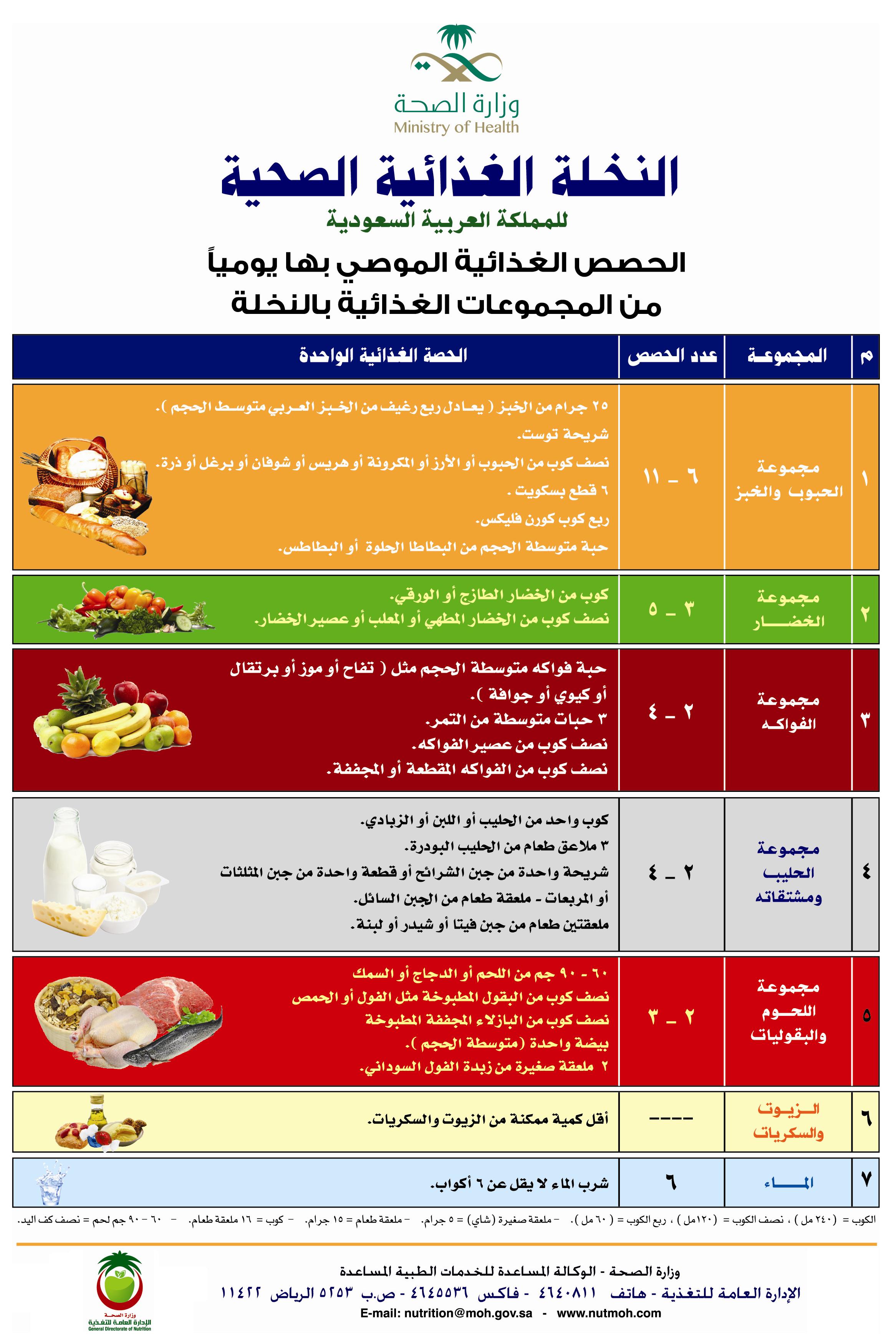
Saudi Arabia's Healthy Food Palm counts half a cup of rice as one serving from the grains group, and recommends 6 to 11 grain servings a day [10]. It doesn't say whether that's cooked rice; half a cup of cooked white rice is about 103 kcal (calculated).
From raw weight to cooked
If you weigh rice before you cook it, use the raw figure. Cooking it in water doesn't change the calories in the pot, only the weight:
| Rice | 100 g raw becomes | 1 cup raw (185 g) |
|---|---|---|
| White, long-grain [1][2] | about 280 g cooked | 675 kcal |
| Sella (parboiled) [3][4] | about 300 g cooked | 692 kcal |
| Brown, long-grain [5][6] | about 300 g cooked | 679 kcal |
Calculated: raw kcal per 100 g divided by cooked kcal per 100 g, from USDA's raw and cooked entries, and USDA's 185 g cup of raw rice. Rice cooked with more or less water than USDA's will weigh more or less.
What changes the number
- Oil or ghee. USDA's recipe for white rice cooked with oil adds 4.7 g of vegetable oil to a cup of rice, and comes to 151 kcal per 100 g, against 129 for the same rice with no fat [7][8].
- Water. Rice that holds more water has fewer calories per 100 g, because the water adds weight but no calories.
- Portion. How much rice is on the plate changes the total far more than the type of rice.
Bukhari, Hassawi and other rice dishes
The Saudi Food and Drug Authority analysed these dishes in a lab, rice and meat together as served [9]:
| Dish, per 100 g | kcal | Protein | Fat | Carbs |
|---|---|---|---|---|
| Bukhari rice with meat (lamb) [9] | 163 | 5.1 g | 8.1 g | 17.3 g |
| Bukhari rice with chicken [9] | 129 | 5.7 g | 5.6 g | 14.0 g |
| Hassawi rice with lamb [9] | 163 | 6.5 g | 6.1 g | 19.3 g |
Carbohydrate here is available carbohydrate. Each recipe serves about 4 adults, according to the tables; a quarter of the pot comes to about 980 kcal for Bukhari rice with meat, 780 with chicken, and 880 for Hassawi rice (calculated from the whole-recipe energy) [9].
For other rice dishes, see kabsa, mandi, machboos and biryani.
How to log it in Voltra
- On the Eat tab, tap Scan a meal and photograph your plate, or tap Describe and type it, for example "a plate of white rice, about 300 g".
- Add a note if the rice was cooked with oil or ghee, or if it's sella or brown.
- Check the grams, then tap Log. If you weighed your plate, use that weight.
Frequently asked
How many calories are in cooked rice?
About 130 kcal per 100 g of cooked white rice, and about 205 kcal in a cup (158 g). Cooked sella and brown rice have about 123 kcal per 100 g.
How many calories are in rice before cooking?
About 365 kcal per 100 g of raw white rice, 374 for raw sella and 367 for raw brown rice. It's the same food: cooked rice has fewer calories per 100 g because it has soaked up water.
How many calories are in 100 g of rice?
It depends whether the 100 g is weighed cooked or raw: about 130 kcal for cooked white rice, and about 365 kcal for raw.
How many calories are in a plate of rice?
It depends on the plate. A 300 g plate of cooked white rice is about 390 kcal, and a 400 g plate about 520 kcal (calculated). Weigh it if you can.
How many calories are in basmati rice?
USDA has no separate basmati entry. Its survey database lists basmati under plain cooked white rice, at 129 kcal per 100 g, built from the long-grain white rice entry (130 kcal).
How many calories are in Bukhari rice?
In the Saudi Food and Drug Authority's lab analysis, 163 kcal per 100 g for Bukhari rice with meat and 129 kcal with chicken, rice and meat together.
Do sella or brown rice have fewer calories?
Per 100 g cooked, slightly: about 123 kcal against 130 for white rice. But USDA's cup of cooked brown rice weighs more, so a cup of brown comes to about 248 kcal against 205 for white.
Sources
- USDA FoodData Central. Rice, white, long-grain, regular, raw, enriched (FDC 168877)
- USDA FoodData Central. Rice, white, long-grain, regular, enriched, cooked (FDC 168878)
- USDA FoodData Central. Rice, white, long-grain, parboiled, enriched, dry (FDC 169707)
- USDA FoodData Central. Rice, white, long-grain, parboiled, enriched, cooked (FDC 169708)
- USDA FoodData Central. Rice, brown, long-grain, raw (FDC 169703)
- USDA FoodData Central. Rice, brown, long-grain, cooked (FDC 169704)
- USDA FoodData Central. Rice, white, cooked, no added fat (FDC 2708408). Survey (FNDDS) entry. Its additional description is "basmati or jasmine rice"; made from FDC 168878.
- USDA FoodData Central. Rice, white, cooked, made with oil (FDC 2708404). Survey (FNDDS) entry. Recipe: 1 cup of cooked long-grain white rice (158 g) with 4.7 g of vegetable oil.
- National Nutrition Committee, Saudi Food and Drug Authority (2025). Saudi Food Composition Tables, 1st edition. Bukhari rice pp. 36–39; Hassawi rice pp. 112–113.
- Saudi Ministry of Health, General Directorate of Nutrition (2012). جدول الحصص الغذائية (النخلة الغذائية الصحية). In Arabic. The Healthy Food Palm servings table.
Sources checked on 6 October 2026. Values are rounded to one decimal place.
Log your food and training with Voltra. Free to download; the yearly plan starts with a 7-day free trial. Works fully in English and Arabic.